I’ve been riding for long enough to know that what “feels” good and and what “is” good in terms of technique are two independent sets with a small intersection; it’s very important to put a lot of thought and research into what you’re doing to make sure it offers a benefit. Research takes “work” and “time”, so I’m not very fond of that approach. Instead, I like to do a lot of “thinking”, leveraging both my inadequate expertise in mechanics and my unusually high degree of confidence in my ability to reason in order to jump to conclusions that benefit my initial assumptions.
For example, I believe there is an advantage to riding sur la plaque, or in the big ring, as opposed to riding in the same size gear on the small ring. I generally find that when I’m strong enough to stay on top of my gear, climbing in the big ring feels less cumbersome than when I climb in the small ring at the same speed. The downside is that it is like playing a game of chicken with your legs; it works very well if you are able to keep the gear turning over smoothly, but should you fall behind the gear, and your speed evaporates as you fall into a spiral of downshifting and decreasing speeds (not to mention morale).
All this can be explained away by having good legs or not (un jour sans), but I think there is a mechanical advantage as well.
First, there is the duration of the effort. As they say, it never gets easier, you just go faster, but I firmly believe faster is easier, provided you are strong and fit enough to support the effort. The faster you climb, the less changes in gradient and road surface impact your speed. Not to mention that while all athletes perform the same amount of work when they cross over the same climb regardless of the duration of their effort, athletes doing so in less time suffer for a shorter period of time than do those who go slower. Marco Pantani claimed that despite knowing the suffering that was just around the corner before his attacks, he was motivated to go as fast as possible in order to make the suffering end sooner.
Second, there seems to be a mechanical advantage of riding in the big ring. I’m a little bit hazy on the physics here, but it seems to me that the crank arm is in effect a second-class lever and, while maintaining the same length crank arm (lever) and fulcrum (bottom bracket), by moving into the big ring, you are moving load farther out on the lever, providing a mechanical advantage over the small ring.
WikiPedia defines leverage as:
load arm x load force = effort arm x effort force
In our case, since the speed is constant, that means that the load force (to turn the pedals) is also constant. And, since the load arm (crank) is a fixed length and the effort arm length is increased when moving the chain to the large chainring, the effort force is reduced in order to maintain a balanced equation, meaning that it doesn’t just feel good to ride sur la plaque, it actually is good.
All that said, this theory completely ignores the energy loss of bending the chain as you start to move the chain from straight at the center of the cassette towards the edge of your cassette, in particular when riding in the big ring and crossing to bigger cogs. Q-Factor has an impact on how much your chain is bending as you ride in bigger and bigger cogs, but I think there’s a measurable loss if you are crossing your chain completely (big ring to biggest cog); and I suspect is is entirely possible that the big ring’s mechanical advantages are outweighed by losses in chain friction.
Posted in: Technique


So moving to a compact drive on my new bike I found that it’s more challenging for me to stay on top of the large chainring. On my old bike I was on the large chainring probably 90% of the time, now I’m on it much much less than that. I like the new look of the velominati btw.
@Marko
Hm, interesting…does that conflict with the theory here? I think it might. I would think your big ring, whether or not it’s compact, should have an advantage over the small ring, and that a bigger ring is better – provided you can get on top of the gear, so I don’t know if what you’re feeling is mechanical or some other factor. We really need our resident physicist, Jim, to chime in here.
Are there maybe other factors going on? Are you in the same position relative to the BB? Maybe you’re spinning more these days than you did before?
And thanks, re: the site. We’re working to get it easier to get to archived content, since readers seem to focus on the most recent post, we’ve simplified the main layout, showcasing comments and recent, popular, and random posts. I’m glad you like it.
Since I’ve swapped to a 34/50 compact crank (I’m old) – It’s changed my riding style. I now live in the big chainring and only use the 34 for actual climbing.
Old school me cringed at using the big ring/big cassette combo for awhile – but now I don’t care. It works without a problem (I’m running 10 speed Ultegra).
With the 50, I find myself going a bit faster and hitting hills a little more aggressively then usual. It’s almost turned my bike into an actual “10 speed” with the 34 ring only used as a bail out gear for steep climbs.
At first, I wasn’t sure I liked the compact set up, but now after a year or so – I dig it.
@Dan O
I haven’t gone compact mostly because I can’t get the Record crank in a 177.5 in anything other than the standard fitting. It would be great, though, because it is so easy to pull the cranks, you could swap out if you wanted to.
I have, however, made the plunge to a 25T pie plate in the back (up from my 11-21 block back in the flatland!) and I’m seriously considering a 26T; since the larger cog in the back should offer the same mechanical advantage with regard not to the crank, but to the wheel. I spend lots of time in the ol’ 39×25 here in Seattle on these grades!
It could just be that I’m fatter and out of shaper. Thing is though, I’m about 2-3 kph faster on my regular routes than I was on my old bike. But i’m mostly on the small ring. So on the one hand I feel like a huge Nancy and on the other I feel like Thor. As far as fit goes, my new bike is certainly more comfy. Which reminds me, I gotta send in those riding position pics for public scrutiny
@Marko
Well, of course you could be fatter or out of shaper, but that doesn’t match up to the 2-3 extra kph’s of love you’re feeling on the training rides.
I’m wondering if this is less a mechanical advantage thing and more just a change in position and new pedaling style? Is it possible you were pushing gears that were too big on the old bike and now you’re just settling into a higher cadence that may work better with your physiology?
I don’t think the size ring you’re pushing is a reflection of your Nanciness. I think the amount you piss and moan about inclement weather is a reflection on your Nanciness and I don’t hear any of that, so we’re good. And, your extra kph’s are definitely a reflection on your Thorness.
The Dutch seem at once scathing and complimentary. How duplicitous.
@Marko
Ha! And the funny thing is, I thought I was being really supportive. The Dutch are so awesome, we don’t even know when we’re scathing!
@Marko
Hmmmmm…….you don’t know Nancy like I know Nancy. I just got passed by a woman today and she was on a compact crank, she spun by as I was crushing the old 39×26 in a sweaty lather. MF’er.
I rented a carbon Trek with a compact crank in Utah and I dug it, maybe the 39 is holding me back? Or I’m an old weak pussy……I’ll let some Dutch guy do the math. I’m afraid to.
Yeah John, I surely would have been passed by her as well or inumerable other Nancy-haters. I’m lucky though, there are only perhaps 15 dedicated cyclists where I live and I’m one of the more fit ones so that doesn’t happen to me often. All my Nanciness comes from within.
and from the Dutch
@Marko
@john
The worst is being out on my swett rig, my kit just so, rockin’ around town like a tough-ass before getting handily passed on a climb by some commuter with a messenger bag, wearing skinny jeans, and riding a fixie. That sound you’re hearing? Deflating ego.
Yup, that would sting a little, Frank.
Trek have done well from Greg in the past when he was the sole American champion so its a shame that things have come to this level now
@Dan O
I destroyed a rear deraillier by crossing the chain… Basically, it caused the chain to come off and get wedged between the chainrings and the chain stay with catastrophic effects… so now I don’t cross the chain.
Can’t you delete this post?
I have just noticed the need for a new rule. Thou shalt never run a compact chainset.
@Jarvis
@david
Noooo! Please only make that a Rule in the Cognoscenti Rulebook. I don’t race, I’m an old bastard, there are steep unavoidable climbs everywhere I turn out here. The compact crankset is my fall back position. I haven’t gone there yet but it’s that or the emergency room or death on the side of the road in the dirt fumbling for my cell phone to call 911 or awaiting the Grim Reaper.
OK, fair enough, maybe that’s what we are talking about? HTFU you big pussy.
@john @all
My suggestion is not only based on style, but on practice as well. When I returned to road cycling (short, boring story), I was on a budget and bought a cheap Pinarello. It came with a compact chainset, it was the worst piece of cycling equipment I’ve used since Bio-pace chainrings. I had to convert each gear into the 52/39 equivalent. It is moronic. I have since replaced it with a proper chainset.
My velomihottie tried the compact for a week before demanding that I remove it and out a proper chainset back on.
It is far more acceptable to put a 28tooth sprocket on the cassette than it is to run a compact.
I must protest. Until I started looking at new bikes I would have agreed. But then, being a math(s) student I did the math(s). If I never/rarely spin out my 53/12 and often don’t even sprint in it, then a 50/12 will probably do… if it doesn’t, I’ll go out and buy a 11-25 Cassette. Besides, try climbing some of the steep stuff round here on a 39/25 when you’re training below 80% HR
I bought said new bike today…
@Jarvis
Yes, it’s Jarvis’ idea. I like it, though. I second the nomination.
@john
NAILED IT. (Said with hand gesture and a soothing timbre to my voice)
@Jarvis
Mine demo’d a Cervelo R3 SL with one installed and nearly refused to buy the bike, she hated it so much. Even going up a 15% grade on the test run, she said, “Fuck this thing. Going into the low gear is like dropping the anchor.”
What’s a compact chainset?
@Nathan Edwards
That’s actually an excellent point. If you’re a giant pussy on the descents, a compact might make sense.
@Steampunk
Same thing as Viagra.
@Nathan Edwards
As much as we love hearing that, that comment is useless without a photo.
@all
Drinking beer and posting is awesome.
@frank
You damn kids with your young bodies and your hard-as-nails wives. The compact(50 and 34 chainrings…Steampunk) only makes sense in the mountains and if you use it to train, like Nathan. You do lose the 53×12 or 53×11 downhill/tailwind ass hauling but it might offset the can’t sit down or bike flips backward, completely redlined, I’m considering walking up this fucker, 20% wall, 39×26 grind I face around here, occasionally, because I’m a big pussy.
@frank
like Jon Stewart?
Drinking beer and posting is awesome. hehehee
@john
I hear tell your velomihottie will drop every one of us on June 19.
@Nathan Edwards It sounds like you are going to race, or are racing, if you want to train strictly below 80% of your max HR. Well, if you are, consider. It’s very easy to spin out a 53×12 in a pack with a 5-10 mph tailwind, if that. It happens all the time. You are likely to get dropped with a 50 x 12, unless you can turn the pedals far faster than everyone else. And if you’re going uphill, aren’t you going downhill? You may get dropped racing downhill with a 50×12. And you’ll never win a downhill sprint.
You may know more than I about compacts. I don’t know anyone with one, but, from what I understand the pros use them only on very steep uphill finishes.
@david Let me rephrase that, following Rule 5. You will get dropped racing down hill.
@frank
shhhhhhhhh! She thinks she will but only because she can drop my sorry ass. She beat me up Mt Washington. She has lost touch with that lonely feeling of going anaerobic and watching people disappear up the road.
@david
For solo training, I think a compact makes sense. It gives you a nice, smooth block with relatively lower gears.
The same way vaseline gives you a nice smooth…Lets just say the standard is better.
I ride a compact. Made the switch through attrition. Came on my cross bike, got moved to the new road frame due to compatability issues and dwells there. Call me a pussy but I like it. It hasn’t made a difference in my riding, only my following of Rule 5 has. I don’t race though (if I did I’d have to drive 5 hours every weekend) so I can see those points. It comes down to the cassette. One of my wheelsets has a 12-27 and the other an 11-25. Big difference there.
@frank That looked like it was about to be a first class piece of sarcasm. Why hold back? Run out of beer?
I still ride a 53-42 and yes there are times when it would be nice to have a bit more spin but right now when I am trying to peak in three weeks a 39 would just seem girlie?
The disadvantage is that you’ll look like Cadel Evans, manhandling his bike, rocking back and forth like drunk sailor trying to find the next bar in the attempt to use his entire body weight to move the pedals one more revolution. The switch to 39s definitely boosted the elegance of the sport.
You know, you can get 52t rings for compact cranksets. So you can have a 52/11, with a 36 or 34 and a 21, 23 or 25 out back for your low gear, depending on how many hills you ride.
In Wellington, compacts make sense. I’ve never run out of a top gear with a 50/11. And even this guy ran compact when he lived here, and he could tear all of you a new one just by looking at you.
@frank
If you insist http://www.facebook.com/album.php?aid=433745&id=661440205&l=8cddb188be
I’ll ride for a while and then might buy an 11-25 then I’ll have a bigger ratio than the 53-12 I have on my other bikes, and I’ve never been dropped for anything other than being worse than the others.
I’ve also realised that the No Compact Rule should be extended to be No Compacts or Triples. It’s all the same, all it does it make you slower. How does that fit into Rule #5. Human nature about not wanting to suffer more than is necessary: if you have a lower gear, you will use it.
I have requirements for a certain level of fitness, any hill/mountain (not sure we have mountains in the UK) that i can’t get up in 39×25, I don’t go up until I’m fit enough. This does mean that on my return to cycling I will be riding up and down the only flat road in the area for months.
I raced on a compact once – I was on a borrowed bike – horribly unfit and still ran out gears
@Rob
agree a 39 is girlie if you’re only three weeks from peaking. When I’m fit*, I’ll ditch the 39 in favour of a 42, I get a better climbing rhythm on a 42.
@john
my wife isn’t hard-as-nails, but she is a Velomihottie.
@Nathan Edwards
Why are you riding up steep hills when on training rides of 80%HR? Or do you not have a choice? If the latter surely the logic works that if you stick with the 39, you will get fit enough to get up the hill at 80%HR, whereas getting a compact just stalls your fitness at it’s current level
*can’t see this happening any year soon
@Jarvis
Got no choice really… probably just my style. Don’t worry I still know how to suffer and when it’s not a sub 80% ride some of these climbs are done at 50rpm or less in a 39-25. I can rule 5 but I’d rather not destroy my knees doing it.
And yes, we have no mountains in the UK, but we do have some steep stuff… just doesn’t go on as long as the Zoncolan.
@Nathan Edwards
So where are you? I was recently trying to class some of the climbs around these parts. The longest climb I can come up with is about 10km and it’s on my doorstep.
@Jarvis
Durham (University)
Longest round here is a bit shorter than that I think, at least one that has any gradient. I think theres one that goes for many km at about 5%, only ridden that one in thick fog/mist, so I have no idea what it looks like.
Jarvis
Avoiding hills because you are too macho to ride a compact is the epitome of soft. While you’re riding around on the flats, real men are climbing hills…
It’s a bit like this…
New Rule: No compacts, triples and knees are not an excuse. HTFU
@brett
Here Here
@brett
That’s fuckin hilariously good shit. Never heard of that guy in the states. Way funny.
@Rob
@Nathan Edwards
@Jarvis
Let’s add carbon frames, clipless pedals, 23mm tires, and 10 speeds to that list too while we’re at it.
@Marko
:)
I’m not the kind of rider to shirk Rule 5 duties… (Which one is it, Holists or Cogniscenti who think Rule 5 is all that matters?)… basically, I’ll ride a bike that makes me go fast, the amount of pain won’t change.
@Nathan Edwards
Dude, still waiting on more beta and pics of that new steed with the compact crank!
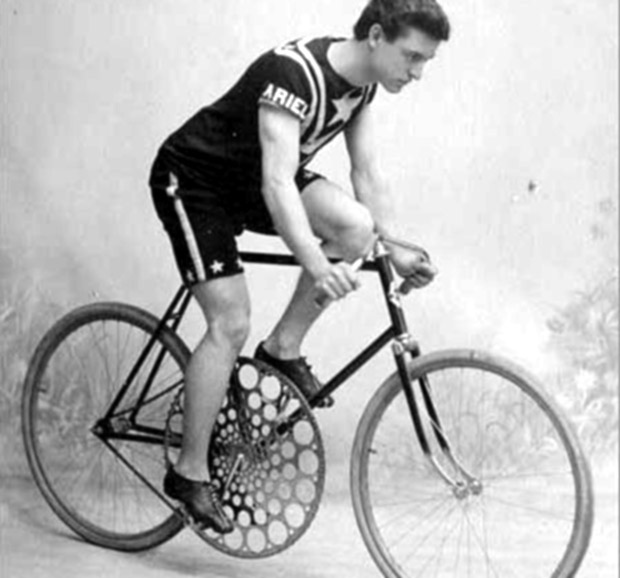
btw, the dude in the picture for this article sort of looks like Joe Strummer. Not sure if he was a cyclist but he certainly lived his life in the big ring.
@Marko
I posted pics http://www.facebook.com/album.php?aid=433745&id=661440205&l=8cddb188be
Boardman – Team Carbon… while I was loath to buy a bike from Halfords (Basically a bike supermarket). That’s where they sell them and this bike is one of the (if not the) best £1000 bikes I could get.
right on. i always find it entertaining checking out bikes that aren’t widely available in the U.S. At least I’ve never come across a Boardman here. I’ll buy a copy of CycloSport America on occasion and dig the adds for Euro bikes I’ll never see in my LBS. Looks like a nice bike. I’ve got the same crankset on my ALAN albeit with c-x sized chainrings (48-36) that oughta get some barbs thrown at me around here.
@Marko
Boardman is a British manufacturer and the company takes it name from and is “run” by Chris Boardman, so I’m not surprised there aren’t (m)any in the US.
Still trying to get used to this double tap stuff. And the thing with buying a bike from Halfords is that basically nothing was setup, I pity the fellow who doesn’t know how to index gears and buys a bike from them.
@Nathan Edwards

Word. I’m familiar just don’t see them here. Hopefully he won’t get bought out by Trek and then have his brand pulled out from under him like Lemond did here ;-)
That’s the evil of bikemarts and online shopping no? Non existant service almost and peeps who think bike maintenance is limited to adjusting saddles, inflating tires, and installing pedals. I guess the upshot is it forces those of us who have no choice but to shop there to become more self-reliant and buy more tools. I’m a perpetual breaker of Rule 58 but then again don’t really have a choice. In fact, I just ordered a set of these online this morning, picked them up at cost.
@marko
what the fuck: 23mm tyres?
@Nathan Edwards @marko
Boardman has quite a bit of involvement in the brand, designing, soucing eqipment etc. Judging on what he has done so far and his justification and general astuteness, I’d be hugely surprised if the brand was sold on to another bike company. Their biggest task is overcoming bike snobs.
@brett @Nathan Edwards
Bollocks to that. I’ll get my fitness first before riding up the really big hills. Even my flat ride has around 200m of climbing in a 18km loop. My point, is that you don’t go and ride up 15-20% gradients on an easy ride – such as the day before a race. Likewise if you’re just coming back from injury and haven’t ridden for six months, every railway bridge will seem like a mountain. But you will not find me on a compact.
Jarvis is on the mark. If you are initially struggling on a hill in your lowest gear, say a 39×23, but HTFU and keep at it, you’ll eventually master the gear on the hill. If you start whining, “I need climbing gears!”, and put on a 25 or 27, you’ll use them, and use them. In the end, you’ll ride slower with the smaller gears.
Having a Rule prohibiting triples would be embarrassing. Like having a rule prohibiting Levis.
But I’m all for a Rule on compacts. It is a matter of style. A matter of protecting the history, traditions, and culture of the sport against the wicked forces of capitalism. Outside of making some compacts for legitimate ends, ferocious race-paced 20% grade climbing, they are good only as a tool for separating you from your money. It’s the same old game. New innovation leads people to buy new stuff rather than to stick with their time-tested old stuff.
I’m a massive girl. And I’m running a compact.
But I’ll get my excuses in early. I’m coming back to cycling after 14 years off the bike following a broken neck. I started riding again in December last year and I’m riding l’Etape in July. On 6 months of very random training.
If that doesn’t follow rule 5 I don’t know what does, so I’ll ask for a temporary rescind of the no compact rules here. I do have a lovely FSA carbon 53/39 set up in shed for the months ahead.
In a funny way it does not matter. I mean were talking about gears and a 89 inch or 49 inch gear is the same on a compact or old school 42-53 so it (as said above) is what you do with it, I am not coming back like Guy, or at least not from a huge disaster like his, my sin was getting old and fat so I am happy to not have the choice. Will I have a compact someday? Probably, but I hope that’s the day I wake up and say “gee that recumbent look like a really intelligent way to go get my beer”.
@rob
It does matter.
It may be that the the gear ratios on a compact or a “normal” are the same. But it’s how they are used and how they are available. Compacts might have a more useable range of gears, but it means that when you shift between rings you have to shift a load at the back and your momentum disappears. The little ring on a compact is only any good if you’re going up hills, the rest of the time you’re in the big ring.
In my book, little ring is for climbing and easy rides and the big ring is for training and racing.
@david
why so protective of triples? If anything they are worse than compacts
@Jarvis Jarvis I am sure you are right but the bottom line is what happens on the road and I see no difference with my shifting pattern compared to my mates in terms of “results”. In fact $9000 bikes, oh wait we now have the new electric shifting in my group (holy!!!!) and spinning hill climbing (and I like to spin with the best) are not dropping my fat ass that often?
So does it really matter or is this just another hollow discussion about preferences? I do not know. I am going to keep with the 42 until my leg can’t turn her over or if I move to where there are serious hills and then it makes perfect sense!
@David “But I’m all for a Rule on compacts. It is a matter of style. A matter of protecting the history, traditions, and culture of the sport against the wicked forces of capitalism.”
Well, going on that logic, you should be riding a steel frame with a threaded headset and quill stem, square taper BB and downtube shifters for your 6 speed cluster.
If you have a carbon frame with 10 speed and aero wheels, or even just one of those, then you’ve just contadicted everything you’ve said about compacts.
@Jarvis No, no. I meant triples are so bad, even so much worse than compacts, that we do not even need a Rule against them.
That doesn’t follow! If new innovations truly make you go faster, stronger, harder, then buy them. I am, however, condemning the widespread distribution of compacts on stock bikes in bicycle shops. Their legitimacy is so narrow in range that they should be for special order only. I mean, if you are recovering from breaking your neck and you can’t avoid hills . . . or, if you are Liquigas rider who has to time-trial up the Plan de Corones, fine. But to sell a budding young cyclist a compact . . . well, I say it’s a freakin’ crime against the Cog.
(Did you sell young Nathan his compact??)
@Nathan Edwards Chris Boardman putting a compact on one of his bikes. What the fuck is the world coming to?
How does an A-Head system make you go faster?
Are you saying the LeakyGas riders who used compacts up Plan de Cojones are soft? Shouldn’t they have just taken a dose of Rule 5 too?
If standard chainrings are too hard to turn over up a steep hill, and a compact means that you can turn the pedals more easily, then surely that equates to going faster up that hill, no? That’s why we see Pros using compacts, 28t cassettes and shit, even some triples on Angliru in the Vuelta in 99.
We are not Pros… the compact is one of the best innovations for the average cyclist in years. By your logic also, the 39t ring is also a crime against the cog. Taking it to the logical conclusion, you should be riding around on a fixed gear, and flipping your wheel around every time you get to a hill.
@brett: “Taking it to the logical conclusion, you should be riding around on a fixed gear, and flipping your wheel around every time you get to a hill.”
Ouch. That hurts, brett. I think it makes sense for the LeakyGas riders to use a compact up the Plan de Cojones. The thing has got 24% grades. The winner up it this year, Garzelli, said he used a 34×29 on the steepest portions. Wow. You want the gearing that will allow you to turn over the pedals smoothly and efficiently. brett: “We are not Pros.” Exactly. If you are a pro racing up 20% grades, a compact, or a 28t gear with a 39 makes sense. If not, then not. Young Nathan says he’s got a 5% grade in Durham. Jesus Christ. A decent cyclist can ride up that with at 39×21 or 39×23. Selling him a compact just means, as Jarvis has said, kind of, that he’s paying to go slow.
There’s a wicked climb out here, in CA, “Mix Canyon”, with a full kilometer at 20%. Chris Horner won a race up it about 6 or 7 years ago, by using a 39×28 rather than a 39×27, which everyone else had. All the power to him. He did what was needed to win.
The 39t ring is not a crime against the cog. Science has shown that high cadences on climbs is better than the old, slogging, climbing we saw 20 years ago with the 42. And, as I mentioned, if the Velominati are about style and aesthetics, then they have to be for the 39, since climbing in it is far more graceful and elegant.
You are contradicting yourself every time you counteract my points!
“You want the gearing that will allow you to turn over the pedals smoothly and efficiently.”
So if that means I have a 10% or a 15% grade to climb, and I am nowhere near as strong as a Pro, then that means a compact will allow me to turn the pedals “smoothly and efficiently”. Remember, I’m talking about the difference between a 39t and a 36t ring, i.e 3 teeth. That’s the same 3 tooth difference between the old standard 42t and a 39t.
“Science has shown that high cadences on climbs is better than the old, slogging, climbing we saw 20 years ago with the 42.”
Correct! Same goes with a 36 over a 39 up a steep grade. If a rider can’t sit and spin in the 39, it means getting out of the saddle and grunting it up and rocking from side to side a la Cadel, but without the obvious power advantage he has over us mortals.
“And, as I mentioned, if the Velominati are about style and aesthetics, then they have to be for the 39, since climbing in it is far more graceful and elegant.”
There’s nothing graceful and elegant about barely turning the pedals at walking pace, is there? And if we were only about style and aesthetics, we would be riding steel frames with quill stems and downtube shifters. But we’re not. we are living in a modern world of technology, and that includes compact cranks, whether you like it or not. No-one is forcing you to ride one, just as no-one made you buy a carbon frame, or STI shifters, or 10 speed gruppos.
The fact is, you don’t like compacts. That’s cool. But to use the defence of “it’s not aesthetic, it’s not traditional, it’s not beneficial” well that is just flawed logic.
@brett Marvelous. But, Brett, you wound me more deeply here than on anything else: “that is just flawed logic.” I’m pretty much following Jarvis here.
@david Yikes, that wasn’t supposed to go out yet. Err, I’m pretty much following Jarvis here. I think what he’s said on the issue is exactly right. Put lower gears on your bike, and you will go slower. True, you want the gears that will allow you to turn over the pedals smoothly and efficiently. But the issue is about your potential. ProTour riders aren’t going to try to climb Mortirolo in a 39×19 gear, hoping that eventually, they’ll master the gear on the climb. It’s just too steep. And they are at, or near, their potential anyway. But for a mortal human being, mastering a 39×23 gear on 5% grade is quite possible. If, initially, you struggle, by following Rule 5, you’ll eventually master the gear, and be able to ride the climb with a smooth, efficient pedal stroke. So, I guess the issue is this.
A. You can start a climb, initially, looking for the gears that will enable you to climb it smoothly and efficiently, or,
B. You can start a climb, with gears that are hard, and get stronger, so that you can eventually climb it smoothly and efficiently.
I speak here from personal experience. I’m in a place where you have to climb out of it to get any decent miles in. I started doing the climb, thinking, Damn, I need some climbing gears. Three weeks later I mastered the gear I initially started climbing in. I HTFU, and mastered the gear.
Damn, I’ve been promoted to Level 1 status. That’s cool.
@brett says, “The fact is, you don’t like compacts. That’s cool. But to use the defence of “it’s not aesthetic, it’s not traditional, it’s not beneficial” well that is just flawed logic.” It’s not beneficial for budding young cyclists, or for those who’ve not already spent years and years climbing. Absolutely no doubt about it. Let’s examine the particulars. Again, young Nathan has a 5% grade of some kilometers. Come on. Honestly, do you think putting him on a compact, to climb in a 34×25 is better for him than telling him to go out, HTFU, and master the gear in 39×23?? Nathan can master the climb in a 39×23, eventually, I’m positive. The only grounds you could have for saying the compact is better is that it is easier. Fuck that. Rule 5.
By your logic, the Pros who climbed Cojones with compacts should’ve just HTFU and used bigger gears?
I never said a compact was ‘better’, but I did say it is valid. And it is. I’m sure Nathan probably climbs that 5% grade in the 50 anyway.
Congrats on your Level 1 status too bro… you climbed up to it so quickly you must’ve been compacting your posts!
That’s enough with the charge of contradiction! You cannot imagine how painful that is. A contradiction is a proposition, P, and it’s negation, ~P. E.g, Compacts are wonderful & It is not the case that compacts are wonderful. To charge someone with a contradiction is to claim that their statements entail P and ~P. To make the case for a contradiction, you have to show what statements entail a proposition, P, and its negation, ~P. You have not done so. Please refrain from the charge until you have discharged your burden.
@david
congrats on Cat 1 status.
@brett @david
compacts are not valid if you want to maximise your performance, they make you slower. So many times I have heard people new to the sport or coming across from mountian biking who say they need a triple/compact to get up the “hills” (in this context “hills” are short <10% gradients). No they don't, they just need to realise that they can get up them, it's mostly in the head and that eventually it gets easier.
To race, you need power, you need to be able to push 53×12 on the flat, and you won't get that from a compact. With all entry-level race bikes sold with compacts and triples anyone starting racing on a budget is at a disadvantage.
Besides, the shifting is all over the place and compacts don't look as aesthetically pleasing.
Yes, the ratio of the big ring circumference to the small ring circumference on a compact is just grating on the eye and mind Good point.
*snigger*
Hoho.
@david
We have a few 20% gradients round here (not that I’ve measured them), defo alot of 12% stuff, that’s what the compact will be useful for. And yes I will be riding up the 5% in the 50 or in 34/15, and still at 90-100rpm.
There are a lot of implicit references to Rule #10 in the recent conversation. If there’s a contradiction in the Cognoscenti way, it’s striking a tidy balance between performance and pushing body and mind as close to the redline for as long as possible.
There’s a fair amount of hills around here that are nasty bastards at 10% and a few of 18-20%. All I know is that right now I need a compact to get up them without dying.
Mind you, I’ve never found it easy to push a 53×12 on a flat solo, so maybe I am a huge girl.
700C Wheel At 90rpm (taken from slowtwitch)
53-39 Rings, 11-21 Cogs 50-34 Rings, 11-21 Cogset
High speed 33.2 MPH 31.3 MPH
Low speed 12.8 MPH 11.5 MPH
Changes between each gear are the same (cssettes re the same). The tradeoff is easier climbing as the expense of a small loss of top speed. This s the lightest configuration for either set up.
53-39 Rings, 11-23 Cogs 50-34 Rings, 11-21 Cogset
High speed 33.2 MPH 31.3 MPH
Low speed 11.7 MPH 11.5 MPH
Low speed now almost the same. 11-23 cassette is heaver with gear ratios wider apart.
53-39 Rings, 12-25 Cogs 50-34 Rings, 11-21 Cogset
High speed 30.42 MPH 31.3 MPH
Low speed 10.74 MPH 11.5 MPH
The 12-25 cassette lowers the top speed on the conventional Crankset and makes climbing easier but at the cost of even wider gear ratios and weight.
53-39 Rings, 12-25 Cogs 50-34 Rings, 11-23 Cogset
High speed 30.42 MPH 31.3 MPH
Low speed 10.74 MPH 10.18 MPH
With slightly wider gear ratios the 11-23 cogs further ease climbing with the Compact Crankset while maintaining top speed.
53-39 Rings, 12-27 Cogs 50-34 Rings, 11-23 Cogset
High speed 30.42 MPH 31.3 MPH
Low speed 9.98 MPH 10.18 MPH
12-27 is about the biggest (heaviest) cassette seen on Tri Bikes. Almost the same climbing can be achieved with the 11-23 cogs with a compact Crankset with a higher top speed, closer gearing and reduced weight.
Again, it’s the cassette. Those of you arguing against compacts, what’s your cassette?
Maybe the weight issue is all about the cassette, but that isn’t what this debate is all about. Not many bikes are sold with compacts and an 11-21. Most are 11/12-25. This is my point.
Maybe it makes more sense if you do run a 21, I would have to check out the ratios where the cross-over is between the big and little rings.
My issue with the compacts are that it’s as much about the action of using the available gears and the the fact that the ratio of the chainrings look wank on compacts.
Besides, on most climbs up to 10% you only need a big ring. Rule #5
I don’t want to belabor the point. (Well, maybe I do.) I don’t really know how the Rules are established. So, I don’t know whether continued discussion has a point or not. But, . . .
Lost in the hunt for phantom contradictions and the mathematics of gearing are the two initial points made against compacts, which have not been addressed by the compactophiles. 1. Jarvis: choose lower gears, and you are choosing to go slow. Jarvis is right. Where you have an option between (A)choosing gears that initially allow you to smoothly and efficiently pedal up hill, and (B), suffering in higher gears until you’re strong enough to master them on a climb, Rule 5 clearly endorses (B). And here we see how magnificent Rule 5 is. If we follow it, we’ll end up a faster, stronger climber in the end–a better cyclist. As Steampunk has pointed out as well, selecting a compact in this situation clearly violates Rule 10 a well. That’s a huge double-hit against the compact. (A young cyclist starting out with a compact!? Who honestly believes that is good?)
2. The difference between a 53×12 and a 50×12 will be huge in many situations, where a 53×12 will be spun out. I like how Marko says the difference between a 53×11 and a 50×11 is a “small loss of top end speed” for the 50×11. Heh. It’s a huge loss of top end speed if you’ll do any riding with good cyclists, whether in races or group rides. Of course, you can monkey around with the rear cog in order to get bigger gears, but then what’s the point? At the bottom end, now, you’ve only got a slightly lower gear than you would if you put a climbing cassette on your standard drive train.
The more I ride with good cyclists, in races or in group rides or just out casually, and the stronger and better I get, the more I’m looking for bigger gears, not smaller gears. When I next change my drive train over, I’m going to a 54×11, with a Rule 5 loving, ass kicking straight block.
Yet Juniors are limited in terms of gearing, so if the gearing is the same what difference does it make if they’re running a compact?
Unless we think it’s a good idea to twat their knees early doors?
Whilst I understand the rule I’m not entirely convinced that its that big a deal. It’s not what you ride, it’s that you ride. No?
@guycollier
new cyclists are not necessarily juniors. and it’s not what you ride, but neither is it “that you ride”, it’s how you ride
I think the thing this discussion is missing is the loss in leverage on the compact set; you’re reducing your lever arm pretty significantly and thus you have a loss of leverage, making the compact relatively more difficult to turn. Further, you’re bending your chain around a smaller circle, which increases friction. Lastly, you are distributing the load on the chain over a smaller surface area, also increasing the resistance.
Physics is on the side of whoever can turn the biggest chain ring.
@Nathan Edwards
Love the Boardman. One of my favorite riders to ever turn a gear in anger. I loved his assault on the hour record, and then his subsequent realization of technology taking over and playing a more important role than the athlete. (He is a cycling gear head and would put any of us to shame. There’s a great piece on him in Rouleur.)
He petitioned the UCI to introduce the Athletes Hour and then proceeded to break it. Amazing guy.
I believe Big Ring Girl Nicole Cooke won both the Olympic and World Championship road races aboard a Boardman. He had a crazy long back, and his frames seem to have a really long top tube. Very cool bikes.
Well done, mate.
One other thing to keep in mind, however, is that being overgeared is also bad. Despite the physics, you have to match your gearing to your ability to turn it. I have gradually been shifting to lower gears, and my speeds increase on the steepest slopes. For more on that, just watch Basso and Evans on the Zoncolan.
In my case, fairly slowly.
I met him when he was racing. Very sound bloke indeed and a legend over here.
The Boardman bikes are remarkable value and really quite impressive.
@frank
If the crank arms are the same length, then there is the same leverage. A 175 on standard rings and a 175 on a compact has the same leverage.
A smaller ring means there is less friction, not more. Look at the pic at the top of the page, there is huge contact of chain and ring, therefrore more friction.
There is also less rotating mass with a compact, so there is less resistance too.
The article Marko sourced is here:
http://www.slowtwitch.com/mainheadings/techctr/gearing.html
@brett
you beat me to the punch.
@frank
Hopefully it will bring me some success, after destroying myself on a 300 mile (why the heck did I do one of those) cyclosportive last weekend, I’ve got to look ahead to two criteriums this coming weekend and the British Unis track championships (I’ve never ridden a track bike :S)
@guycollier
I distinctly remember back at the age of approximately 10 (so the year Lance won his second Tour), the days I still believed Boardman could win the Tour. My Father didn’t bother to dispel the idea. Anyway, I distinctly remember when on holiday in the lake district, walking somewhere, and seeing a cyclist in full Credit Agricole kit coming the other way, who greeted us with a polite good afternoon. Myself and my Mum both being little versed in velominati-ness looked at the rider and the kit. My Dad of course looked at the bike, and said he hadn’t seen the rider. Anyway a discussion ensued, the conclusion being that we had just seen Chris Boardman :)
Oh for the naïve days of youth.
@frank
leverage, that’s the monkey. bang on the me
@brett
but crank length is important to correct positioning on the bike. And being able to pick and choose cranklength is fine for those deep-of-pocket or in the trade, but most bikes that have compacts are not sold with optimal performance in mind but with ratios that are lower to get up hills easier without the need for the weight penalty of a triple and with longer cranks to allow more leverage to get up hills more easily.
I run 172.5, but compact’s generally come in 175. Now this next bit might be an old-wives tale – I am no physcist – but the longer the crank the more leverage and so the longer it takes to turn the crank. Fine for getting up hills more easily, but not so good for jumping on the wheel of the guy’s who has attacked down the opposite gutter.
Also, if compacts are lighter and have a better range of gearing as that slowtwitch article suggests, then why don’t the all the PRO’s use them in races as well as for training?
@Jarvis
I’m gonna have to do some sums now…
Basically, if we model it physically, the friction/resistance forces aren’t going to change much between the two. So all that matters is moments (leverage). I’ll do some sums.
Btw, I think the cranks on my new Boardman are 172.5 anyway.
Ok Physics done… If the ratio of chainring to cassette is the same (basically if you are pulling the same length gear – how do you work out that inches thing for gears?) it doesn’t actually matter how big either of them are, what actually matters is the length of the cranks compared to the radius of the wheel. Longer cranks mean less force required, but as Jarvis pointed out you have to push through further and less responsive. So it probably makes no difference at all.
@Nathan Edwards
Are you taking into account the placement of the fulcrum? I mean, in your equations, are you also taking into account where on the crank the load is being placed? To make an extreme example, if you put the chain directly on the bottom bracket, you’ll have very little leverage to turn the gear. Conversely, if you put the chain on the pedal, you’ll have loads of leverage. The length of the crank is only a part of the equation.
Also, we’re all ignoring the distribution of the load across the chain ring.
Also, here’s chart on the friction table for gear ratios. Here’s an interesting block I just found in a blog post that linked to this article (which also claimed my assertion in the article is bullocks):
@Jarvis “compact’s generally come in 175.”
Wrong. The crank lengths are determined by bike size. I’ve just done a scan of all the bikes on the shop floor, and for e.g Tarmacs (standard) and Roubaixs (compact) all have the same crank lengths for each comparitive size. Small (52cm) have 170s, Mediums and Larges (54, 56cm) have 172.5 and XLs (60cm) have 175.
@brett
Have you ever found one in a 177.5? My failure to find them has kept me out of the potential client pool for a set myself.
It’s a shame, too, because cranks are so easy to switch these days, it would be nice to engage in some pedal doping every now and again.
Dura Ace compact comes in 177.5 and 180. SRAM Red comes in 177.5, and also offers a 52/36 compact.
Campy doesn’t offer a 177.5.
@brett
That’s what I thought.
One more thing on the compacts before I retire from this absolutely awesome conversation:
The argument that a compact has less rotating mass is ridiculous; given the size of a crankset, unless you’re comfortable spinning at 4356 rpm, there can’t be a measurable difference. It makes a difference in wheels which, at 700c are much bigger than a crank, and rotate several orders of magnitude faster than you pedal. But on a crank set? I’m not buyin’ it.
Of course I’m not, and I doubt Jarvis is, advocating 50 rpm big gear climbing. Like I said, the science is clear. Higher rpms on climbing is better. But surely spinning up hill at 90 rpm in a 39×23 is better than spinning up hill in a 39×25.
@Marko Sorry. Didn’t see you were quoting someone there. “The tradeoff is easier climbing as the expense of a small loss of top speed. This is the lightest configuration for either set up.” Which, any way, I still assert is crazy, either for a road racer or a tri-guy. There’s some strange stuff in that article I”m not familiar with. Because fat is the most available source of energy, you should pedal at 90 rpm? Huh?
@david
I’m with you, David. That article makes some big jumps that I’m not following. I’m not a physio, but I always thought many of the things the article attempts to standardize were based on physiology and vary pretty significantly from person to person. Oh, well. I guess next year every pro will be riding a compact at 90rpm, all day, every day.
Then Brett will be able to move all his compacts off the floor, and get a new bike for himself.
@frank
Basically, the smaller the Chainring, the less opposing turning force there is against you pedaling
BUT in order to keep the gear ratio the same the cog will have to be smaller, which will be creating less turning force. So the change in size of the chainring and cassette cancel each other out.
@david
I posted that article in here primarily for the technical data, not the dude’s assesment. That said, my assesment of the tech data underscores that it’s really so dependant on the cassette that all this back and forth about the chainrings is a bit like hitting our heads against the wall, again and again and again
Well, I appreciate what the article is saying, and I would say it just depends.
Where I ride it is mostly rollers, all over. Hill after hill after hill. We big ring everything because it maintains momentum, and once over the hill you recoop so much momentum so much faster it really is significant. Our hills though range from 1/2k to 2-3k at the longest, up from 100m to 300m at the most. They are just short intervals. That said, I can beat and out run most compacts given the same routes and all because of the length of the gear. And forget triples, I just don’t like them at all.
I don’t agree that big ringing the Alp’s however is better. The long mtn pass’s that go on really require one to find a cadence and spin that is optimized for it. Big ringing isn’t it til descending.
@Marko
Well, the back and forth on chain rings (at least for me) has to do more with mechanical advantage than speeds and cadences, which is what the data you provided speaks to.
To me, it definitely feels better to ride the same size gear in the big ring versus the little ring.
@Nathan Edwards
But that doesn’t take into account the considerably bigger diameter and angular momentum of the wheel, not to mention that the diameter (and then also the leverage from the cog) is relatively much smaller between the 16 and 21 (for example) that you would be switching between when riding roughly the same size gear in the big vs. small ring. Whereas on the crank set, you’re looking at something closer to a 1/3 bigger diameter/more leverage.
@Souleur
Aside from the weight and aesthetic concerns associated with triples, I’ve found it incredibly hard to maintain shifting quality with a triple because the rear dérailleur just can’t accommodate the changes in chain tension between the rings. Then you start looking at medium or long-cage dérailleurs and I don’t think we even want to start that discussion.
@brett
so it’s the taller people who are forced by manufacturers false assumption of physiology into buying bikes with cranks that are too long for them?
I appreciate the science that smaller gears are lighter and by customising your gearing should give you equivalent gearing. So in that respect are better.
It certainly doesn’t equate in practice, especially for racing cyclists.
Anyway, this has been a fascinating discussion and I will leave it with the fact that compacts are wank and have no place in the Velominati.
@frank
Oh but it does. The difference in Chainring is cancelled out by the difference in cog.
@Jarvis, @brett
Crank length based on frame size is as good an assumption to make as any, but it’s something that the rider/bike fitter should definitely take into account and have the option to swap out for their optimal length.
Brett, I have to say I’m puzzled by the choices that Specialized has for crankset types – the Tarmac gets a standard while the Roubaix has the compact? With the Tarmac being the better climber, I’d definitely expect those to be the other way around. Any thoughts on why they went that route?
I’m late to the conversation, but I’ll relate my own experience. For years, I was on a 52/42. Moved to a 53/39 on my Colnago in ’96 and realized climbing seated was nicer on my knees, less energy wasted and my speed increased. Bought a cross bike in ’06 to also use as a commuter and found that the supplied 46/36 sucked as I was spinning out all the time. I like to pedal down hills, and found I couldn’t. So I bumped to a 50/34 compact. Still had a 53/39 on my nice bike and just adjusted to whatever I was riding that day. The compact was great when pulling 2 kids in a trailer (over 100 pounds) up 15% hills. HTFU!
Curretly (and sadly) a one bike guy for the first time in 20 plus years, and I’ve got a 50/34. Last year when the car snapped my tibia and fibula, I needed a compact to spin the easiest gears possbile. I’m making due this season with the one bike, and finding that as my legs have come around I’m not using the easiest gears. I do most of my climbing in the 19, and will move up if I’m riding the steep stuff. I say if you adhere to rule #5, you will choose the gear that makes you fastest. We all know if you have the legs, nothing else matters. I’d be happy to invite anyone to Portland for a hilly ride that includes plenty of 20% or more hills. A compact can be handy at times. And I can pedal up to 45 mph going down in the 50/11. That said, I don’t know if I’ll do compact or standard on the nice bike that I’ll be getting over the winter. The aesthetics issue isn’t bad for me as I’m on a 50cm bike with 170′s. The compact looks fairly “normal”. I feel like I’ll have a better idea of which direction to go after this season. A compact on a 15 pound bike might be overkill.
On a side note, my best to all who are doing the Tour de Blast tomorrow. You’ll have a great time. It can be very different weather on top, so be prepared.